
I post daily, but deliver to your inbox every Sunday. Browse past newsletters HERE. Book Rich. Bring the speed of Asia to your next event HERE
Read me first
“A stablecoin is only worth a dollar where money can move freely.” In much of Asia, money can’t, so the market sets its own exchange rate, and adoption pays the price.
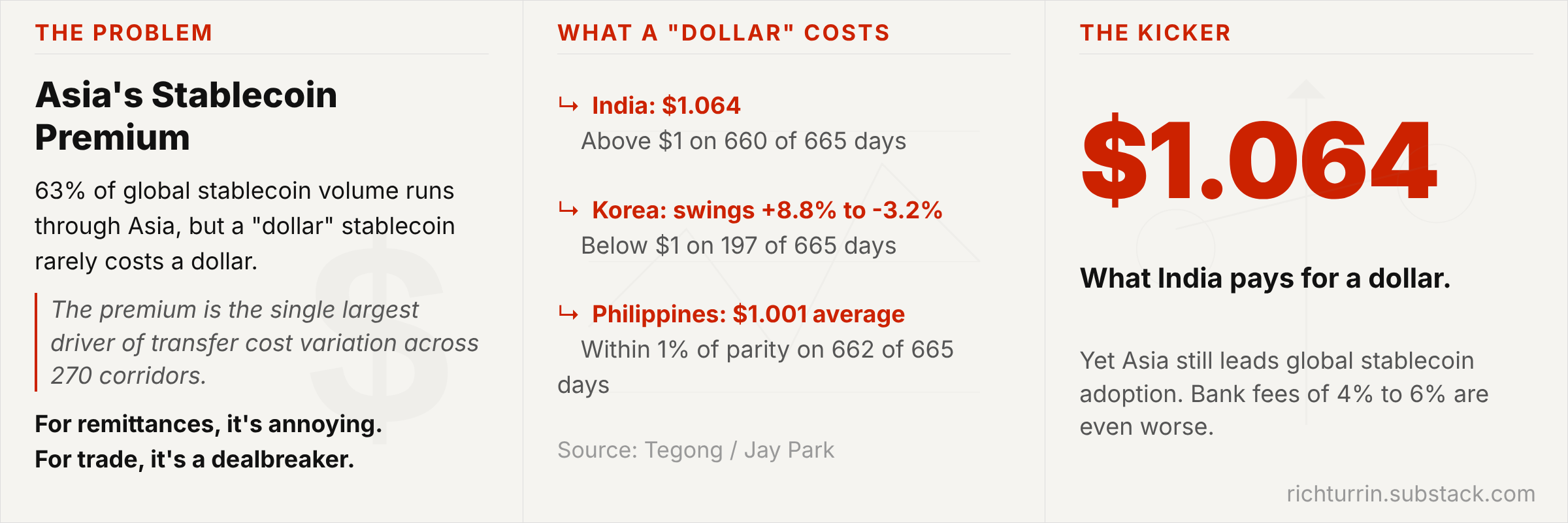
Asia is the world’s largest user of stablecoins, accounting for 63% of global stablecoin volume in 2025, but it isn’t always easy because stablecoin prices vary widely.
Pricing can be so variable that Korea’s “Kimchi spread” is infamous, making stablecoins harder to use in trade because users never know what price they’ll get.
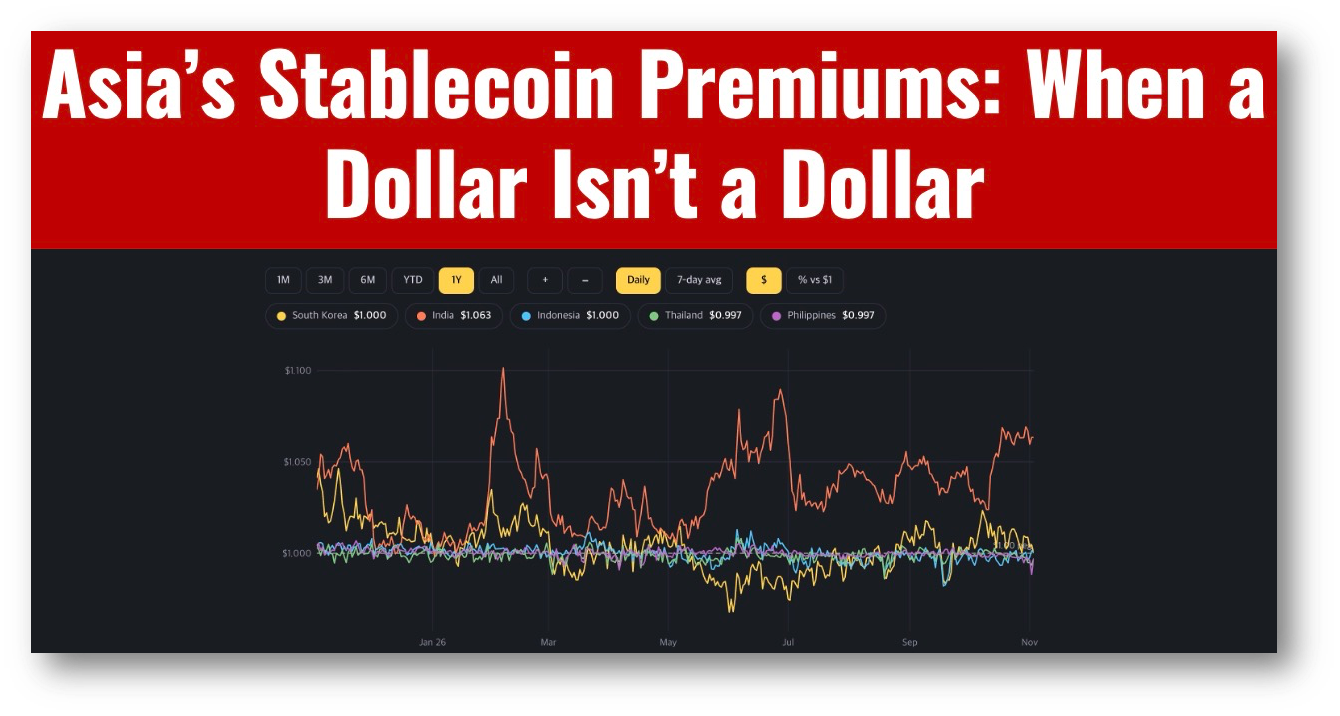
Nowhere is Asia’s stablecoin pricing variability better illustrated than by Tegong, an Asia-focused crypto data site run by Jay Park, who generously supplied the data for this article.
Park’s Asia Tether Dollar Index tracks the actual dollar value of one USDT across five Asian markets daily, showing how stablecoins’ goal of being a fixed dollar asset isn’t being realized.
See Part 1: Learn how Stablecoin premiums impact transfer costs
Read Part 1 to see how the IMF found that emerging-market premiums, where a “dollar” stablecoin costs $1.03 or more, cut costs when you’re receiving but jack them up when you’re sending. That swing ran from -3.07% to +4.51% depending on direction. Strip out the premium and the savings story collapses.

What the data shows
India is the worst. USDT has traded above a dollar on 660 of the last 665 days. Today it sits at $1.064, a 6.4% premium. A business paying a $100,000 invoice in stablecoins is shelling out $106,400 worth of rupees. India’s 30% crypto tax, plus 1% TDS and banking frictions, keeps local USDT permanently above a dollar.
Korea swings both ways. As Park puts it, “Korea shows that the gap can run both ways: an 8.8% premium in February 2025, a 3.2% discount by June 2026.” Korea sat below a dollar on 197 of 665 days. Korean exchanges trade only in won, foreigners cannot open accounts, and moving money in or out takes bank and FX paperwork. The same capital controls that inflate the premium in a boom prevent it from narrowing in a slump.
Indonesia, Thailand and the Philippines tell a different story. All three trade in a narrow band around parity. The Philippines averaged $1.001 and stayed within 1% of a dollar on 662 of 665 days. Thailand averaged $0.999, within 1% on 648 days. The small “discounts” are mostly measurement noise and normal trading costs. Where money moves more freely, stablecoins actually hold their peg.
Why the gaps persist
Three forces drive the variation:
Barriers: Where money cannot move freely, local USDT drifts from a dollar and stays there. India’s tax regime and Korea’s closed exchanges are the clearest examples.
Liquidity: Median daily volume ranges from about 73 million USDT on Korea’s Upbit to about 1 million on India’s exchanges. Thin books in India add noise on top of the structural premium. Much of India’s real volume runs on P2P and offshore venues instead.
Volume direction: Thailand likely has more people selling USDT for baht than buying it, fitting a country receiving tourists, remittances, and crypto inflows. That tilts the price slightly below a dollar.
What it means for trade
The IMF’s recent working paper on stablecoin transfer costs (HERE) studied 270 corridors and found the premium is the single largest driver of variation in stablecoin transfer costs. It is the premium that separates cheap from expensive transfers. Corridors with a high premium pay more to send dollar stablecoins and gain moderately when they receive them.
For remittances, Asia’s biggest use of stablecoins, a variable premium is annoying. For trade finance, it can be a dealbreaker. A Korean importer paying a supplier can’t budget when the stablecoin surcharge swings from +8.8% to -3.2%. An Indian manufacturer can’t treat USDT as a dollar equivalent when it may cost 6% more than a dollar.
Stablecoins work where capital moves freely. In parts of Asia where adoption matters most, the premium problem turns a dollar stablecoin into a variable-rate instrument.
Yet despite these problems, Asia leads in stablecoin adoption, showing just how punishing bank transfers with average fees ranging from 4% to 6% can be.
Stablecoin premiums don’t make using them easy, but in many use cases they still beat the bank.
HAND CURATED FOR YOU
🚀 Asia moves fast. So does this newsletter. I curate only the best fintech, CBDC, and AI insights from 50+ sources weekly so you stay ahead of what’s coming West. Subscribe and never fall behind.
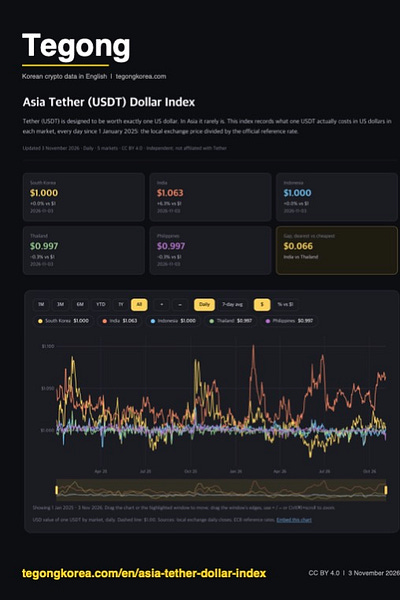
The most recent chart of the Asia Tether Dollar Index can be found HERE

If you know someone who would like this newsletter, please share it with them and help grow our Asia, CBDC, and AI aficionados community!
