Book Rich. Bring the speed of Asia to your next event HERE
Thanks for reading the “Cashless” newsletter, an insider’s view on Asia’s fintech, CBDC, and AI for anyone serious about “the Asia Century.” I’m Rich Turrin, and these are my hard-hitting insights designed to help you — whether you’re in finance, tech, or consulting — stay ahead of the pack. Free is great. Premium is your unfair advantage.
Topics:
Banks’ Three Options for Tokenized Money: Third-Party Stablecoins Finish Last
The Fed on Stablecoins: All Upside, No Downside
The AI Reckoning: 89% Still Aren’t Ready
Goldman Sachs Says AI Isn’t a Bubble: 99.5% of the Economy Still Untouched
Dive into the Knowledge Vaults — Start with a Free Read
Chart and Art of the Day — China’s AI Models Are Winning Over American Companies
Happy Sunday,
I’m back from holiday, feeling refreshed and eager to write, though these shorter articles were written while still away. I really never stop!
Check out the photos in the ‘Art of the Day’ section to see what I was up to.
This week’s edition is split between stablecoins and AI.
Stablecoins are looking to take over bank transfers, but one look at the capital efficiency numbers shows this isn’t going to happen.
Do you ever wonder how we got so deep into stablecoin hype without anyone ever looking at the numbers? This is at least my third article complaining that for banks, holding them at scale doesn’t make sense.
The Fed looks at stablecoins and sees the world through rose-colored glasses, begging the question: aren’t they supposed to look at what can go wrong?
Meanwhile, for AI, McKinsey and Goldman Sachs both have articles showing how we’re still in the early days of the AI revolution.
Goldman makes a case that there’s no AI bubble. I’m less certain that AI profits will pay off the debt.
While I regularly complain in this newsletter about the lack of ROI on most AI implementations, these are still early days, and we’ve got a lot further to go before AI delivers on its promise.
Premium readers, I haven’t forgotten you while on holiday. There are eight new articles waiting in the Banking Vault this week, including the FCA’s landmark AI blueprint for financial services.
Long-time followers will know I’ve been writing about how China’s open-weight models have been a game changer for years. Check out today’s “Chart of the Day” to see how corporate America finally agrees.
Thanks for reading. I’m grateful you’re here.
Rich
P.S. You read it, I write it. If there’s a topic I’m missing or a report I ought to know about, tell me. The best ideas come from readers.
Banks' Three Options for Tokenized Money: Third-Party Stablecoins Finish Last
Third-party stablecoins will cost banks $0.85 on the dollar to hold on balance sheet
Third-party stablecoins have an uphill climb with banks. Of the three tokenized money options, they rank dead last for capital efficiency when compared with tokenized deposits and consortium stablecoins.
Not a day goes by without third-party stablecoins being touted as the digital money destined to transform payments. But when you look at the numbers for banks, they don't add up.
Why do third-party stablecoins face a steep capital hill?
Hold one on your balance sheet and Basel's Net Stable Funding Ratio (NSFR) assigns it an 85% Required Stable Funding factor.
That means for every $100 of stablecoin inventory a bank holds, it must lock up $85 in long-term stable funding against it. That makes holding an inventory painfully expensive.
But wait, it gets worse.
The cash reserves a bank converted to buy that stablecoin were High Quality Liquid Assets (HQLA), the best assets a bank can hold for its Liquidity Coverage Ratio (LCR).
The moment a bank swaps them for stablecoin inventory, they stop counting as HQLA. The bank loses liquidity credit and takes on a penalty by funding the position at the same time.
For the privilege of holding third-party stablecoins, two hits to the balance sheet for one position.
The three kinds of tokenized money:
Tokenized deposits: claim stays a deposit, Basel treatment preserved, narrow venue reach
First-party stablecoins: bank-controlled rail, but Basel treats 100% of issuance as a stress outflow and gives zero funding credit
Third-party stablecoins: widest venue reach, but holding inventory costs 85 cents of stable funding per dollar and strips HQLA status from the reserves used to buy it
Banks will facilitate stablecoin access for clients; post GENIUS Act, how can they not?
But holding inventory on balance sheet?
The capital math kills it.
Enter consortium stablecoins. OpenUSD has Visa, Mastercard, Stripe, and 140+ partners launching across multiple chains this year.
Europe's Qivalis has 37 banks across 15 countries building a MiCAR-compliant euro coin.
Both consortium coins offer on-chain settlement, broad distribution, and no capital penalty.
All the benefits touted by third-party stablecoins without the capital drag.
The notion that third-party stablecoins conquer institutional payments may sound nice to some, but banks simply built their own to prevent this from happening.
The math doesn't lie.

The Fed on Stablecoins: All Upside, No Downside
It’s a problem when the Fed’s paper on stablecoins reads more like advocacy than analysis.
The Fed looks at stablecoins and sees no way they can lose. Is this an educated opinion or politically motivated propaganda?
What's most interesting about the Fed's analysis of stablecoins is that there is no scenario where they lose.
The Philadelphia Fed lays out three futures for stablecoins:
They become a mainstream medium of exchange for everyday transactions and cross-border remittances, replacing slow, expensive bank transfers.
They serve as a store of value for international investors who want dollar access without a U.S. bank account, particularly in high-inflation countries like Turkey and Nigeria.
They remain a blockchain-native asset confined to crypto trading, where 88% of transactions already live.
All three scenarios end well for the dollar, though I suppose staying confined to crypto could be considered a failure.
That said, note how none of these scenarios raise serious concerns.
This is despite fears of money laundering and the creation of a two-tier dollar system where stablecoins get easier KYC/AML treatment than bank transfers.
Think this sounds remote?
Consider that the world's largest stablecoin, Tether, with over 60% of the market, has never had a full independent audit and will now operate a US GENIUS Act stablecoin.
This gives Tether users a choice of dialing down AML/KYC compliance by using the non-GENIUS-Act-compliant stablecoin.
Then the greatest irony of all is how the Fed skips over how USDC only survived the SVB collapse because the Treasury, Fed, and FDIC bailed out depositors.
This was hardly the private free-market money that Washington is promising.
Instead, it's private money that privatizes the gains and socializes the losses through bailouts when things don’t go according to plan.
Will OpenUSD founders look for similar bailouts if something goes wrong?
Stablecoins have a real role to play in payments. But the GENIUS Act alone does not mitigate the real risks stablecoins bring.
When the Fed can't find a single downside scenario, it makes me question their independence and whether they've crossed over into advocacy.
The AI Reckoning: 89% Still Aren't Ready
The 11% redesigning workflows are nearly 4x more likely to see the ROI
McKinsey says only 11% of companies are reinventing themselves with AI. Do the 89% know something McKinsey doesn’t, or are they hopelessly doomed?
McKinsey once again decries that companies are not ready and not moving fast enough to reach for the pot of gold that lies at the end of the agentic AI rainbow.
The real question is whether the pot of gold is for McKinsey’s rich consulting engagements or whether companies are genuinely missing out given the speed of AI progress.
Their latest global survey of 750 leaders and employees shows that McKinsey is on to something.
The three horizons, and do they pay?
Enablement: 46% of leaders, only 13% report real value
Automation: 43% of leaders, 24% report real value
Reinvention: 11% of leaders, 48% report real value
Reaching reinvention nearly quadruples your odds of capturing value, yet 89% haven’t gotten there.
Show me the proof
McKinsey may want the consulting fees, but the data holds up: the gap is the company’s, not the employees’.
70% of employees say they’re ready for AI, while only 27% of leaders say their organization is ready to change around it.
McKinsey claims organizational readiness explains 48% of the gap between winners and laggards, personal readiness only 25%.
And the stats move in for the kill.
Leaders who redesign workflows are 5.3 times more likely to capture value, while leaders with an AI-fluent leadership team are 3.9 times more likely.
As far as banks are concerned, this is a repeat performance of their digital transformation efforts.
They brought in designers, made a good-looking front end, but kept the org chart the same and wondered why the ROI never showed, and neobanks ate their lunch.
Can companies, and banks in particular, break the cycle this time, or are they doomed?
Goldman Sachs Says AI Isn’t a Bubble: 99.5% of the Economy Still Untouched
$2 billion a day in AI investment and the impact on the real economy is just starting
Goldman Sachs just made the strongest case yet that AI isn't a bubble, as 99.5% of the real economy is still untouched.
The AI investment numbers are stunning. Global hyperscaler CapEx is projected to reach over $760 billion in 2026, approximately $2 billion per day.
But the question everyone is asking is: Is this a bubble?
For now, the impact on the real economy has been limited, with software the canary in the coal mine as it is the first to feel AI disruption.
Today, SaaS, the area most impacted by AI, accounts for less than 0.5% of global GDP.
The real economy, the other ~99.5% of the global economy that AI has barely touched, from manufacturing and robotics to defense, construction, and energy, defines the actual scale of opportunity.
Understanding how much further AI has to go in transforming our world is why this Goldman report is so important.
Bubble or not?
~$7.6T total AI CapEx projected 2026-2031 across compute, data centers, and power, many times the capital deployed during the dotcom era
US AI investment equals only ~1.2% of GDP today; railroad buildouts ran 3-4.5%
AI labs growing at multibillion-dollar revenue numbers, not vaporware
AI will expand the total market for automation/enterprise software by ~2.5x over the next decade
On the side of bubble: capital is running ahead of revenue with the sector's 10 largest holdings shedding ~$800B in market cap
Also concerning: Chinese AI models now account for roughly half of all token consumption, up from low single digits in late 2024 at a fraction of US frontier pricing.
Does AI's 1.2% of GDP investment feel like a bubble to you, or are we on the cusp of a technological revolution that we haven't even begun to see play out in full?
My take is that we haven't seen anything yet.
Dive into the Knowledge Vaults. Start with a Free Read
Knowledge Vaults are your curated edge across six high-impact themes: AI, banking, CBDC/tokenization/payments, stablecoins, macrotrends, and Asia.
Every resource is hand-picked for quality, no filler, no padding. These are living documents, updated weekly and growing fast.
Premium members get exclusive access to all six vaults and first look at everything added going forward.
New This Week in the Banking Vault: Eight Reads Worth Your Time
New to the Knowledge Vault this week: 8 articles anchored by the FCA’s Mills Review, the most comprehensive regulatory blueprint for AI in financial services published anywhere, and a sharp Deutsche Bank Research note on why AI’s finance takeover is choking on adoption, not capability.
From there, the Vault goes deep on digital wallets as infrastructure, quantum readiness as a business decision, the IMF’s case that tokenization won’t kill intermediaries but redesign them, and the perception gap between how ready industry thinks it is versus what regulators actually see. If you’re tracking where finance, AI, and infrastructure collide, this week’s collection is the raw material.
🔓 Every week I give members a free read of the first two articles.
Free to Read in the Vault
FCA Mills Review is the most detailed regulatory blueprint for AI in financial services published anywhere. It maps four systemic shifts hitting by 2030, from agent-led consumer journeys to fraud scaling faster than defenses. If you operate in financial services, not just the UK, this is the direction of travel.
Deutsche Bank Research finds 30% of US banks already use AI and another 34% plan to start within six months, but 99% accurate isn’t accurate enough in regulated markets. The gap between what models can do and what institutions will let them do is what we have to watch.
Read both free. Then ask yourself what else you’re missing.
Click on the Vault link below👇
The Knowledge Vault: Banking 2026 – The Year Disruption Gets Real

Knowledge Vaults are your curated edge across five high-impact themes: AI, banking, CBDC/tokenization/payments, stablecoins, and Asia.
Chart and Art of the Day!
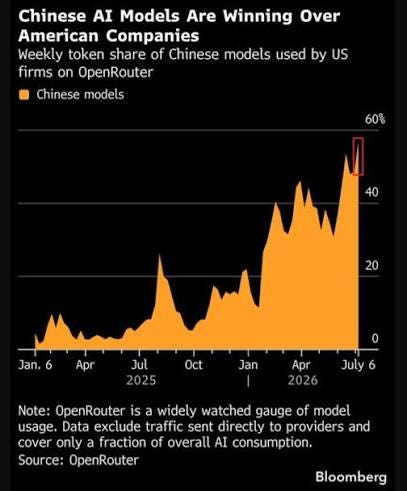
Chart of the Day ✦ China’s AI Models Are Winning Over American Companies
Regular readers will know that I have been proclaiming that China’s open source models were game changers for several years. Well, it looks like US businesses have finally caught on.
Chinese AI models now account for nearly 60% of tokens processed by U.S. firms on OpenRouter, up from less than 10% at the start of 2025.
The shift isn’t theoretical. It’s showing up in infrastructure spending decisions right now, and it has everything to do with price, performance, and the fact that China’s model gap with the U.S. just hit a record low.
How will the US’s hyperscalers pay off their massive debts if companies switch to low-cost models?
The gap is closing fast. Bloomberg Intelligence reports Chinese AI models narrowed the performance gap with U.S. counterparts to a record-low 6% in June, down from 9% in May. The time lag has compressed from six to twelve months to roughly three months.
Moonshot’s Kimi K3 proves Zhipu wasn’t a fluke. The 2.8 trillion parameter open-weight model outperforms all rivals except Claude Fable 5 and GPT-5.6, and got so popular Moonshot had to suspend new subscriptions within 48 hours of launch.
Cost is the accelerant. DeepSeek V4 Flash costs $0.14 per million input tokens versus $5.00 for GPT-5.5. Open-source Chinese models are consistently 60% to 90% cheaper, and companies like DoorDash and Airbnb are already switching.
U.S. model share on OpenRouter collapsed from 70% to 30% in one year. The reversal is the sharpest platform-level shift in AI infrastructure since the transformer era began.
Art of the Day: Below the Surface, Richard Turrin, 2026
I am an avid diver and underwater photographer. Here are a few shots of creatures large and small from my recent diving trip to Komodo National Park in Indonesia.