
DLT Interoperability Threatens Tokenization: No Progress Since 2024, Fragmentation Risk Rises
Digital securities are just hype without interoperability, and no, stablecoin rails won't do.
This is my daily post. I write daily, but send my newsletter to your email only on Sundays. Go HERE to see my past newsletters.
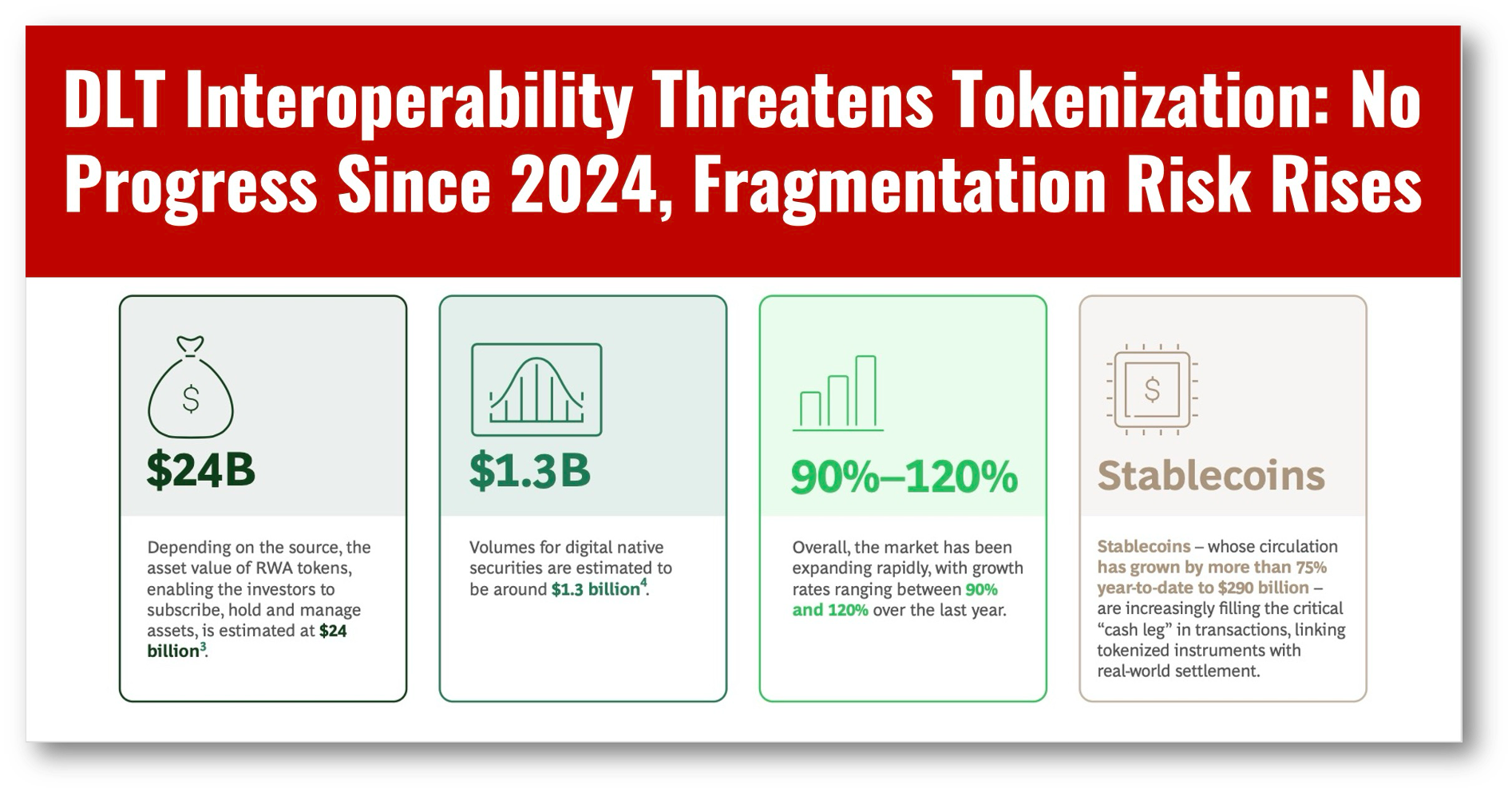
Kudos to the DTCC, Clearstream, Euroclear, and BCG for working on bringing DLT interoperability to securities because, until they or the NYSE set the standards, market fragmentation is a real risk.
My first article on DLT securities interoperability dates back to April 2024, and I’m frustrated because we still haven’t tackled DLT interoperability.
All the hype around tokenized/digital securities — 24/7 trading, lower costs, instant settlement — remains just that: hype.
This is so basic it’s shocking that no one has tackled interoperability at scale.
Interoperability in capital markets can be defined as “the ability to exchange assets across ledgers – DLT and traditional – while preserving the asset’s integrity, ownership rights and lifecycle, with full legal and regulatory compliance.”
In other words: “same asset, same rights, same outcome” across both rails.
Crypto and stablecoins don’t help
Crypto fans will tell you that they have digital securities already, and that is true, but they don’t live up to industry standards and are not interoperable.
So, despite the factual boasting that they were first to market with digital securities, they didn’t build a system that fosters interoperability.
Similarly, stablecoin fans think that the chains they run on are uniquely suited to this role as being the chain around which interoperability is built.
This is even more absurd since USDC runs on 125 blockchains, and USDT on 170!
Talk about fragmentation!
NYSE and NASDAQ to the rescue?
One possibility, and I don’t think this is far-fetched, is that the NYSE and NASDAQ tokenization programs will end up defining interoperability based on their standards.
That may sound good enough for equities, but it won’t work for bonds and other markets with specific standards.
But here is the real problem: as ad-hoc DLT adoption surges in capital markets, NYSE and NASDAQ efforts included, there is a real risk of market fragmentation.
Fragmentation traps assets in silos, inflating operational costs, fragmenting liquidity, and may lead to inefficiencies that are worse than traditional markets.
Moving forward isn’t rocket science
So, how to move the market forward? Brace for it:
1. Data standardization – creating common identifiers, taxonomies, and message standards, as financial markets did in the past with ISIN.
2. Process harmonization – ensuring minimum definition of core processes such as settlement, reconciliation, and corporate actions, replicating the efficiency gains achieved in traditional finance through SWIFT standardized protocols.
3. Consistent roles assignment – clearly defining responsibilities for critical functions (for example, custody, validation, oversight), as traditional finance achieved with custodians, CSDs, and clearing houses, to preserve accountability and trust.
Three years on from my first piece, we’re still at square one on scaling this.
Does this latest white paper give you confidence that DLT securities/tokenization are truly around the corner... or is it still mostly talk?
👉Takeaways
Interoperability is a prerequisite for DAS adoption at scale.
The current interoperability limitations already create tangible frictions: operational costs are high, liquidity is fragmented, and both operational and regulatory risks remain while volume increases. Without overcoming these barriers, the expected benefits of digital asset securities will be difficult to achieve. Interoperability can enable the seamless execution of foundational use cases, facilitate the scaling of complex ones, and unlock entirely new opportunities. By ensuring the mobility, liquidity, security, and fungibility of assets, interoperability lays the foundation for widespread DAS adoption.
Interoperability extends beyond cross-DLT data integration.
Interoperability is built on 5 enduring capital market foundations: assets and liabilities, ownership, asset lifecycle and movement protocols, ledgers, and legal and regulatory compliance. These foundations have remained relevant for decades, and interoperability across all of them is essential to enable asset exchange across DLT or between DLT and traditional ledgers.
Interoperability requires industry-wide effort.
FMls, regulators, market participants, and technology providers should build infrastructure and create standards around data harmonization, process integration, and harmonization of roles and critical functions. The framework described in this paper serves as a neutral reference point to convene this harmonization - helping establish a common taxonomy, anchor outcomes, classify initiatives, and highlight both coverage and gaps.
Interoperability should be advanced through a value-led approach.
Defining a market-level phased approach, with each phase focusing on a set of high-value use cases, enables actors to focus on the most critical interoperability areas and address the most important frictions. Each phase should be anchored in measurable outcomes and tested across multiple DLT and traditional finance ledgers. This prioritization leads the way to full scale interoperability over time.
Collective action today will shape resilient markets tomorrow.
In traditional finance, it took decades of effort and crisis management to harmonize market processes, data standards and integration approaches. To accelerate and reduce costs, market participants, technology vendors, regulators, and FMIs should come together to identify the salient priorities.
HAND CURATED FOR YOU
🚀 🚀 Every week I scan thousands of articles to find only the best and most valuable for you. Free readers get the weekly highlights — paid subscribers get the full knowledge vaults, deeper analysis, and the real edge. Upgrade today.

If you know someone who would like this newsletter, please share it with them and help grow our Asia, CBDC, and AI aficionados community!
