
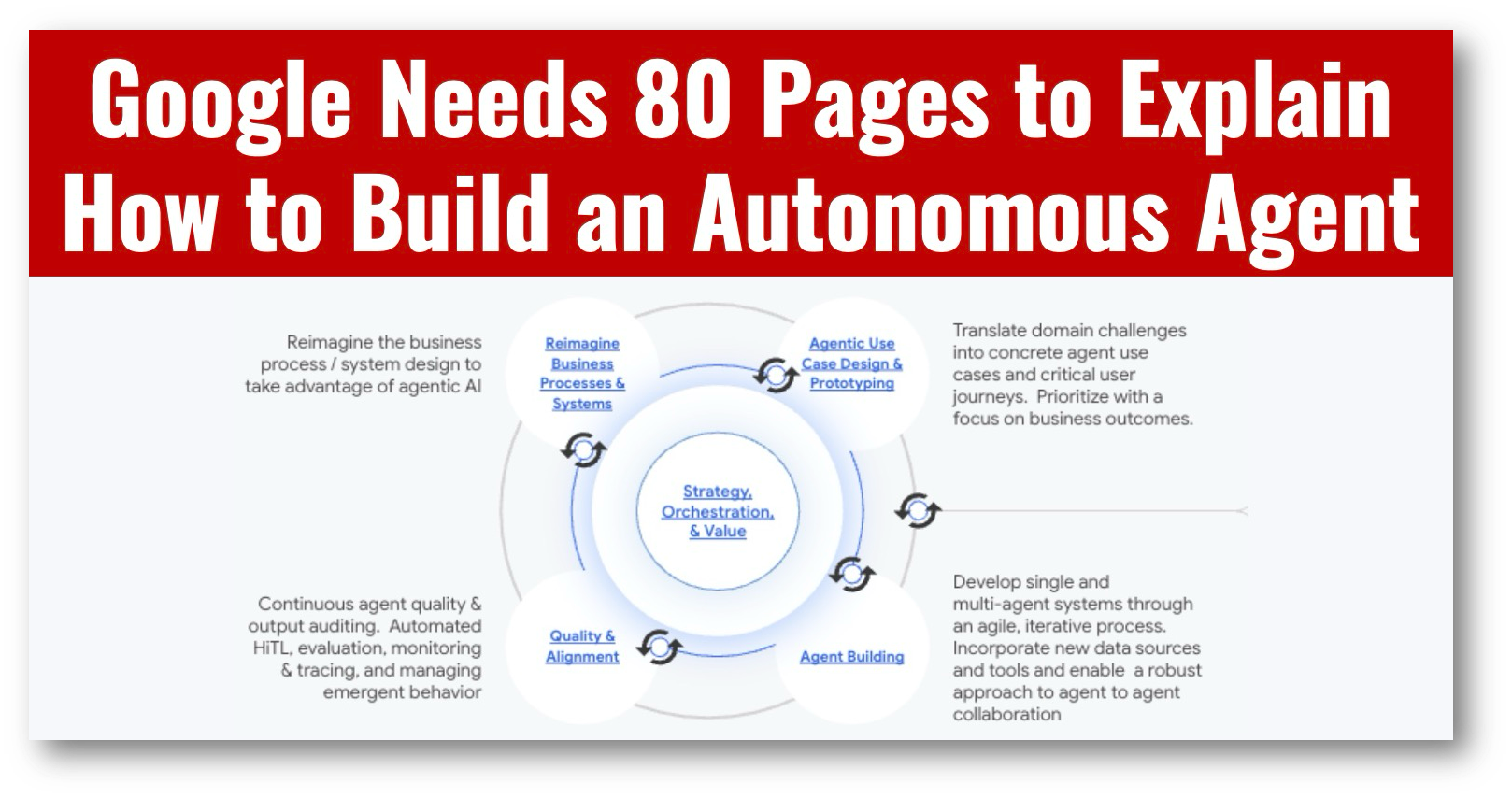
Google Needs 80 Pages to Explain How to Build an Autonomous Agent
A "how to" guide that shows just how hard they are to build
I post daily, but deliver to your inbox every Sunday. Browse past newsletters HERE. Book Rich. Bring the speed of Asia to your next event HERE
Read me first
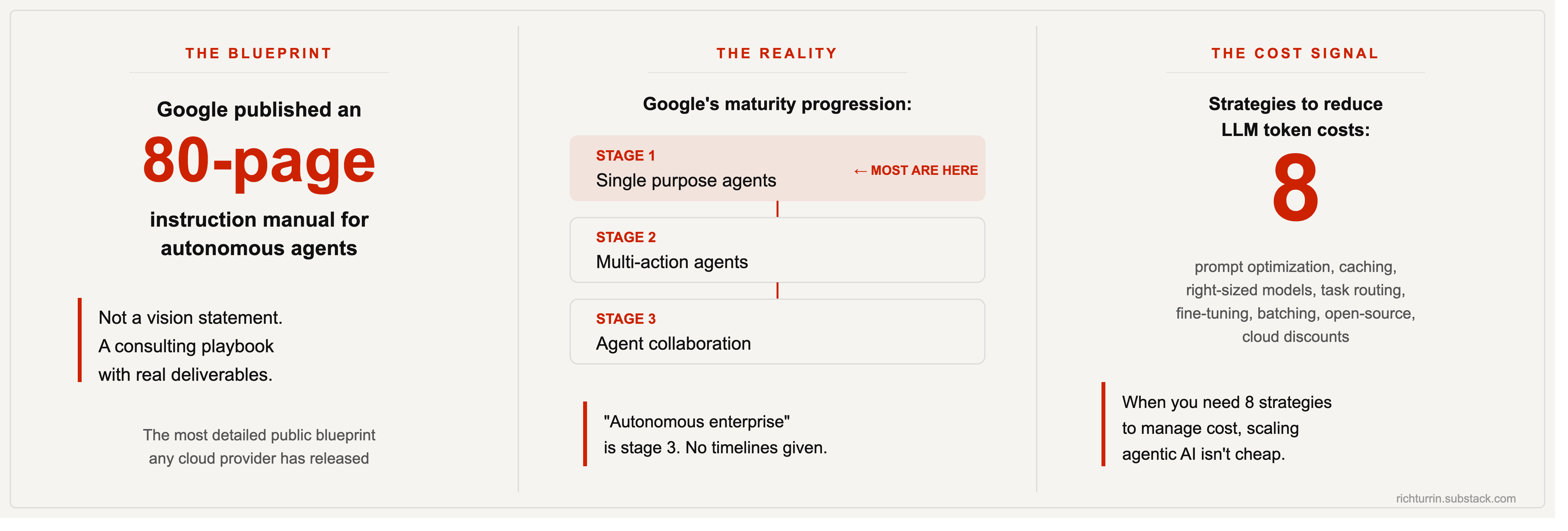
Google wants us all to work in “autonomous enterprises.” The problem? It takes an 80-page instruction manual to get there.
This is the most detailed public blueprint any major cloud provider has released for building and scaling enterprise agents.
It’s not a vision statement. It’s a consulting playbook with specific architecture patterns, maturity stages, roles, deliverables, and cost strategies.
If your company is trying to figure out where to start with agentic AI, this is the closest thing to a manual that exists, and I give credit to Google for writing it.
While Google isn’t wrong to promote autonomous enterprises, the grim reality is that most companies are miles behind.
The army of consultants, governance boards, and cost-optimization strategies required before a single agent negotiates with a supplier shows how massive this effort is.
It directly refutes consultants’ reports that say it will be easy, and even a quick skim will reveal how true that is.
Author's note: Few will read all 80 pages, but even a skim of the contents reveals the considerable level of detail required in governance and integration. Building the agent is the easy part.
I’m not being negative and believe that companies will get there. The question is whether it will happen fast enough for Google and others to pay off the massive debt they are incurring on data center investments.
Google is honest and sees a progression from Single Purpose Agents → Multi-action Agents → Agent Collaboration & Orchestration.
Where it is less forthcoming is in admitting that most enterprises are at stage 1. The “autonomous enterprise” is stage 3 and is a way off for most companies.
Google also does a great job of trying to allay the fear that agents will be expensive, a real problem at a time when companies are looking to reduce their AI bills.
It suggests 8 separate strategies for reducing LLM token costs: prompt optimization, response caching, right-sized modeling, dynamic task routing, fine-tuning smaller models, request batching, open-source models, and cloud discounts.
When you need 8 strategies to manage costs, you’re signaling that scaling agentic AI isn’t cheap and that the companies paying for it are carefully weighing the costs.
Readers should even be slightly surprised that Google recommends open-source models. Even if not explicitly mentioning that these are mostly Chinese, that’s the path many companies will take to reduce AI costs.
Google wrote the instruction manual for autonomous agents, but autonomous agents aren’t like assembling IKEA furniture.
The instructions alone will be overwhelming for many companies.
HAND CURATED FOR YOU
🚀 Asia moves fast. So does this newsletter. I curate only the best fintech, CBDC, and AI insights from 50+ sources weekly so you stay ahead of what’s coming West. Subscribe and never fall behind.

If you know someone who would like this newsletter, please share it with them and help grow our Asia, CBDC, and AI aficionados community!
