
HBR: AI Promised Less Work – Instead It Intensifies Workloads and Fuels Burnout
Companies need policies to protect humans from AI overload.
This is my daily post. I write daily, but send my newsletter to your email only on Sundays. Go HERE to see my past newsletters.
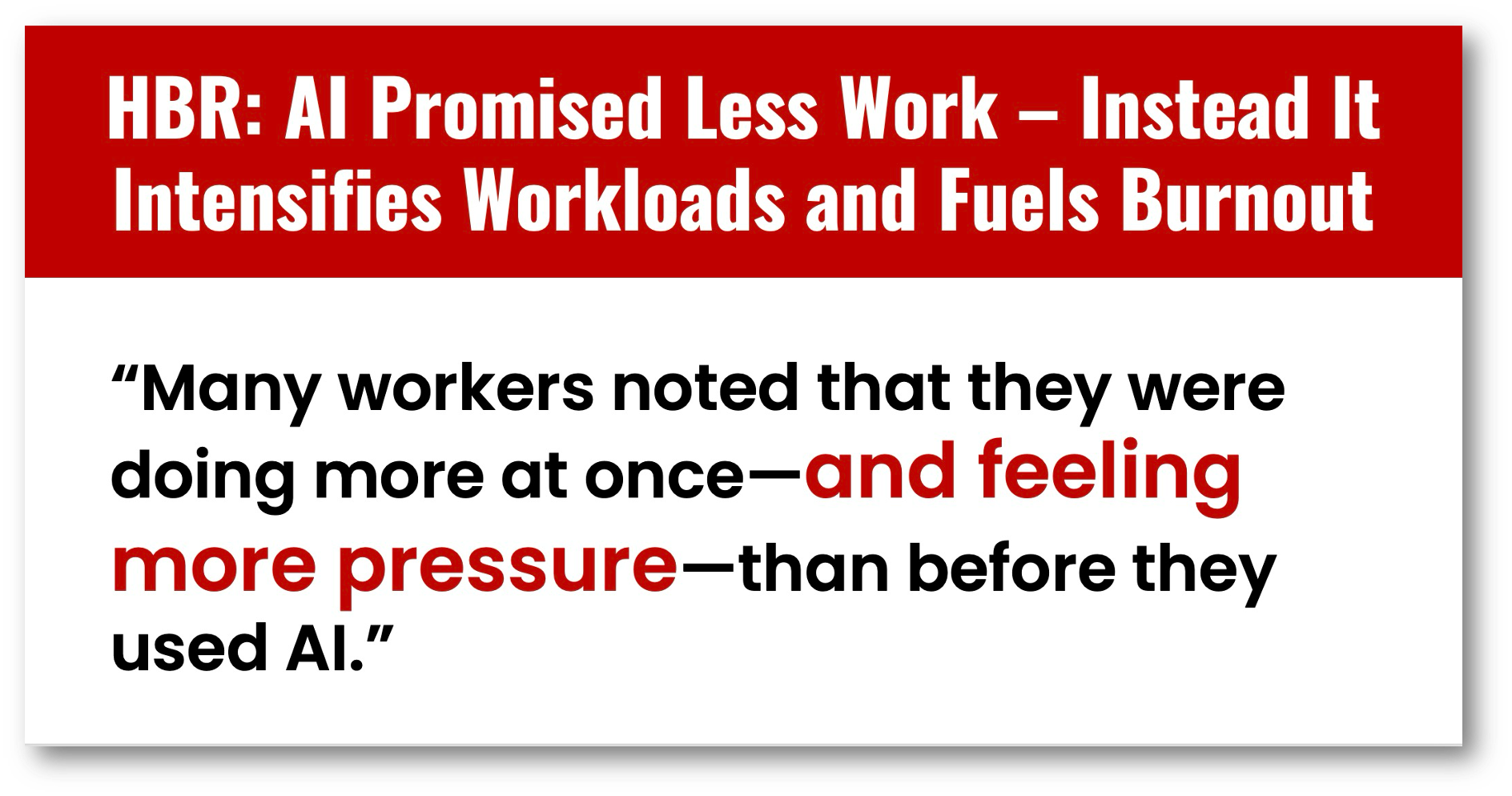
Harvard Business Review, drops a bombshell by claiming that AI isn’t reducing anyone’s workload, but is actually intensifying it and making it unsustainable.
The results of an eight-month study at a tech company with 200 employees may sound like every manager’s dream:
“We found that employees worked at a faster pace, took on a broader scope of tasks, and extended work into more hours of the day, often without being asked to do so.”
…and it gets even better…
“Workers did more because AI made ‘doing more’ feel possible, accessible, and in many cases intrinsically rewarding.”
The problem for workers is burnout:
“Once the excitement of experimenting fades, workers can find that their workload has quietly grown and feel stretched from juggling everything that’s suddenly on their plate.”
“That workload creep can in turn lead to cognitive fatigue, burnout, and weakened decision-making.”
The study found that companies will need to adopt an “AI Practice.”
“AI Practice: a set of intentional norms and routines that structure how AI is used, when it is appropriate to stop, and how work should and should not expand in response to newfound capability.”
This set of policies is specifically designed to help humans and AI reach the critical balance allowing humans to work comfortably with AI.
The risk is that without these policies, AI will simply amplify the existing incentive system that generally rewards more output, making employees simply work more.
This doesn’t mean that employees will work smarter, be more innovative, or otherwise “think” to the benefit of the company, but they will produce more output regardless of how flawed.
Companies need to be proactive in adopting an AI practice for employee well-being, just as they do with adopting AI risk management and governance programs.
Expecting this balance to happen magically by itself is a fundamental error.
Or will companies just accept employee burnout and make humans sacrificial?
👉Three factors increase AI intensity:
1️⃣ Task Expansion
↳ AI automates routine tasks, freeing humans for higher-level work — but instead of reducing workload, it expands the scope and volume of tasks people now handle.
↳ Workers take on more complex, judgment-intensive responsibilities as AI shifts low-value work away, creating a broader and more demanding role.
↳ Result: job descriptions grow, with employees expected to oversee AI outputs, correct errors, and manage exceptions at scale.
2️⃣ Blurred Boundaries
↳ Work and personal time merge as AI enables constant availability (e.g., real-time monitoring, always-on notifications, remote access).
↳ Employees struggle to disconnect — AI tools encourage 24/7 responsiveness, eroding traditional work-life separation.
↳ Mental fatigue increases as the line between “on” and “off” disappears, leading to burnout risks.
3️⃣ Multitasking
↳ AI accelerates task-switching — workers juggle multiple AI-driven workflows, dashboards, and decision points simultaneously.
↳ Cognitive load rises sharply as people monitor AI performance, handle interruptions, and pivot between high-context activities.
↳ Productivity paradox emerges: more speed and tools lead to fragmented attention, reducing deep focus and increasing errors.
HAND CURATED FOR YOU
🚀 🚀 Every week I scan thousands of articles to find only the best and most valuable for you. Free readers get the weekly highlights — paid subscribers get the full knowledge vaults, deeper analysis, and the real edge. Upgrade today.

If you know someone who would like this newsletter, please share it with them and help grow our Asia, CBDC, and AI aficionados community!
