
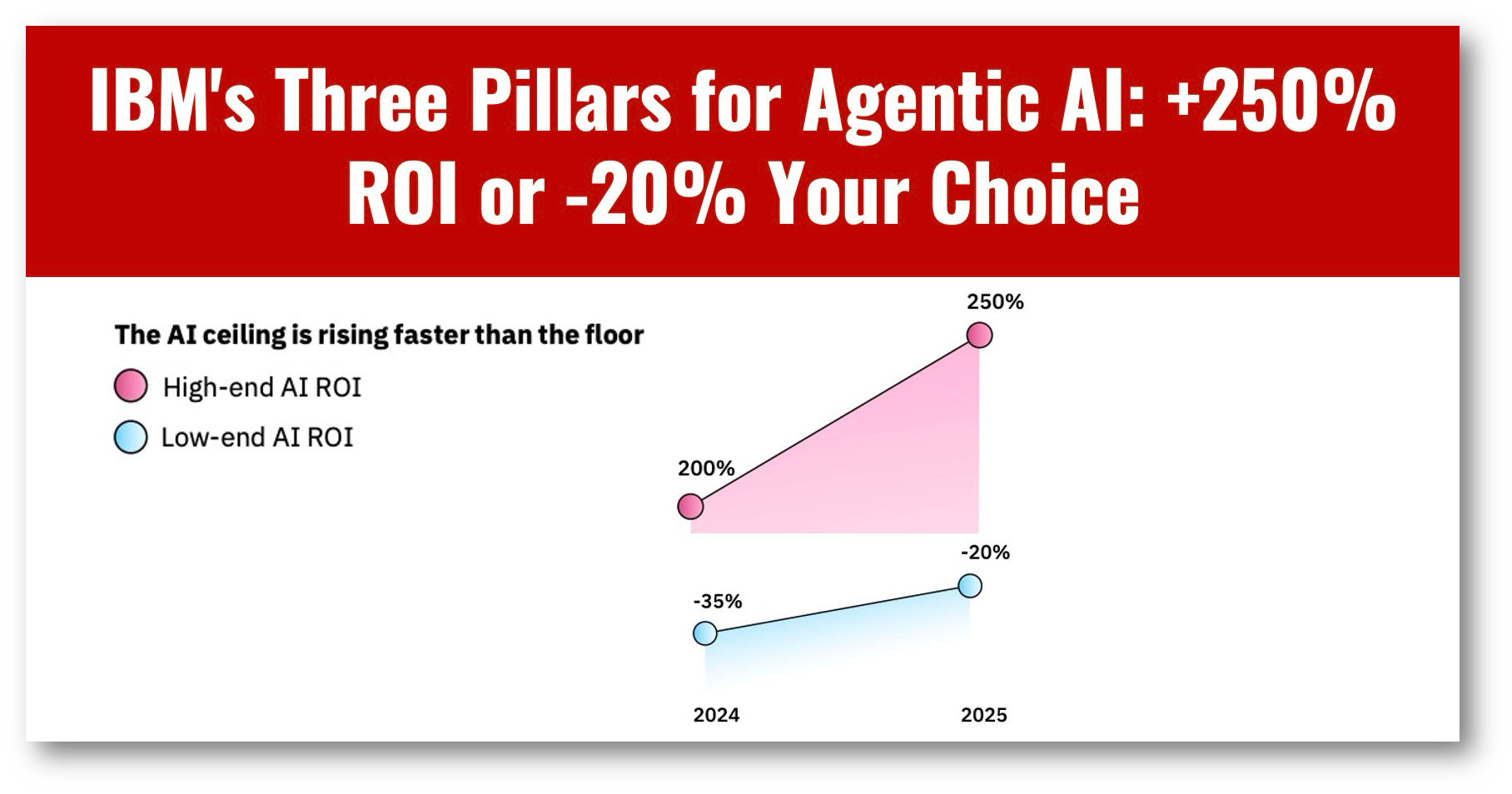
IBM's Three Pillars for Agentic AI: +250% ROI or -20% Your Choice
Why banks are likely on the wrong side of the ROI gap
I post daily, but deliver to your inbox every Sunday. Browse past newsletters HERE. Book Rich. Bring the speed of Asia to your next event HERE
Read me first
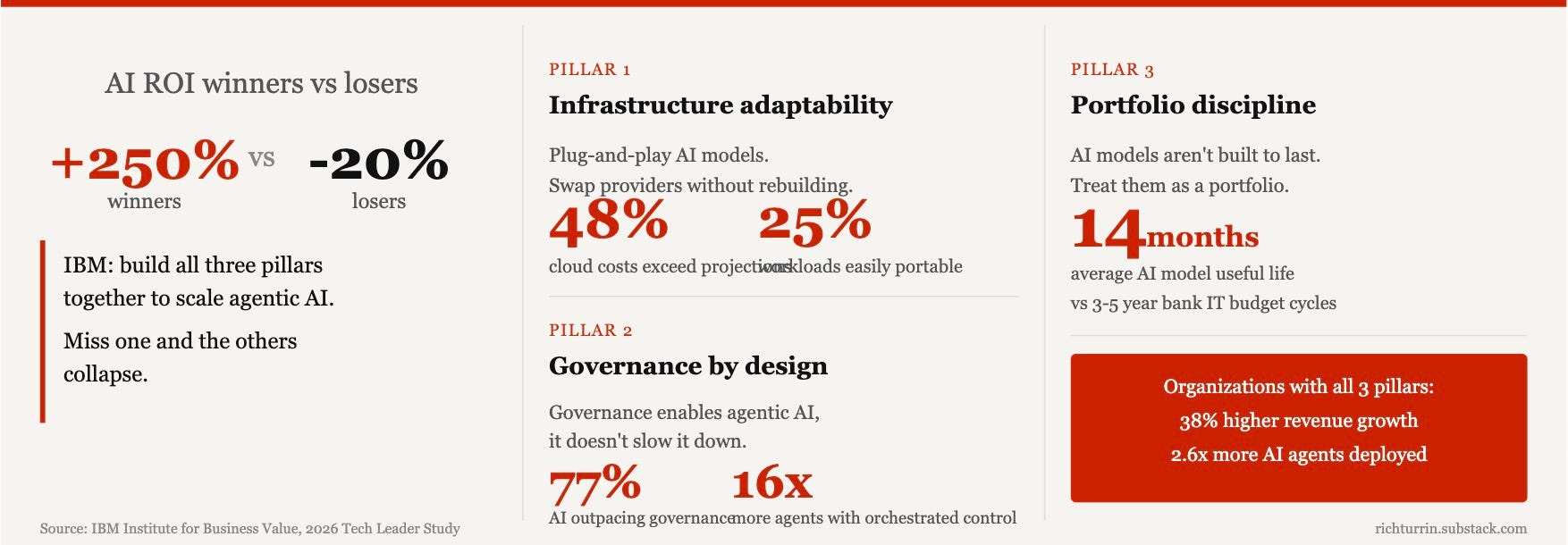
The gap between AI winners and losers is already 250% ROI vs -20%, and IBM just explained why.
IBM surveyed 2,000 CIOs and CTOs across 33 geographies and concluded that you must build all three pillars together to scale agentic AI.
The pillars demand fast changes in infrastructure, governance, and AI models, all things banks are traditionally bad at.
Miss one and the others collapse, which is why most banks are likely closer to -20% ROI than +250%.
Speed on one pillar might be possible, but speed on all three simultaneously is a different story.
IBM’s three pillars:
Infrastructure
IBM’s prescription is optionality: the ability to shift workloads, rotate AI models, and absorb new capabilities without triggering large-scale disruption. Think plug-and-play infrastructure where swapping models doesn’t mean rebuilding systems.
That flexibility extends directly to cloud architecture, and here most organizations are badly exposed. Cloud costs already exceed projections by 48% on average, and only 25% of workloads are easily portable.
That lock-in has a direct cost: slower market response, weaker vendor leverage, delayed model adoption. Organizations that designed for optionality early reported 10% higher AI ROI in 2025.
Governance
IBM’s key insight: governance doesn’t slow agentic AI, it enables it. But what constitutes control is changing fast. Agents make decisions continuously and at volumes no escalation path to manual oversight can realistically govern. Manual oversight becomes a scaling trap. The data already shows the damage.
↳ 77% say AI adoption is outpacing governance capabilities
↳ Organizations averaged 54 AI agent incidents last year
↳ 37% resulted in data exposure or security breaches
↳ 33% caused cascading system failures
IBM’s answer is orchestrated control: governance embedded into architecture itself, letting federated teams move fast inside safe limits rather than waiting for downstream review. The payoff is striking. Organizations with orchestrated control deploy 16x more agents than those relying on manual governance.
Portfolio discipline.
Think your new AI models are built to last? IBM finds the average useful life is just 14 months. Measured against the 3-to-5-year asset lifecycle driving bank IT budgets, the incompatibility is structural, not incidental. IBM’s recommendation: treat AI investments as a portfolio, not individual projects. The enterprise learns faster and scales proven capabilities without one-at-a-time approval delays.
Yet 85% of organizations still lack real-time AI spend visibility, even as AI budgets head from 15% of IT spend today to nearly 25% by 2027. That’s a 71% increase while flying blind on costs.
Three pillars, not two or one
IBM found that organizations building all three pillars together reported 38% higher expected revenue growth and 7% higher operating margins and are already deploying 2.6x more AI agents than peers.
The numbers are compelling, but a bank building only one or two pillars is left with the proverbial one or two-legged stool. For most incumbent banks, all three pillars are at best aspirational.
The real story is the AI ROI gap between winners at 250% and losers at -20%.
HAND CURATED FOR YOU
🚀 Asia moves fast. So does this newsletter. I curate only the best fintech, CBDC, and AI insights from 50+ sources weekly so you stay ahead of what’s coming West. Subscribe and never fall behind.

If you know someone who would like this newsletter, please share it with them and help grow our Asia, CBDC, and AI aficionados community!
