
Stablecoin's Biggest Risks Hide in the Plumbing – The Infrastructure No One Talks About
The GENIUS Act left out more about maintaining stablecoin stability than it put in.
This is my daily post. I write daily, but send my newsletter to your email only on Sundays. Go HERE to see my past newsletters.
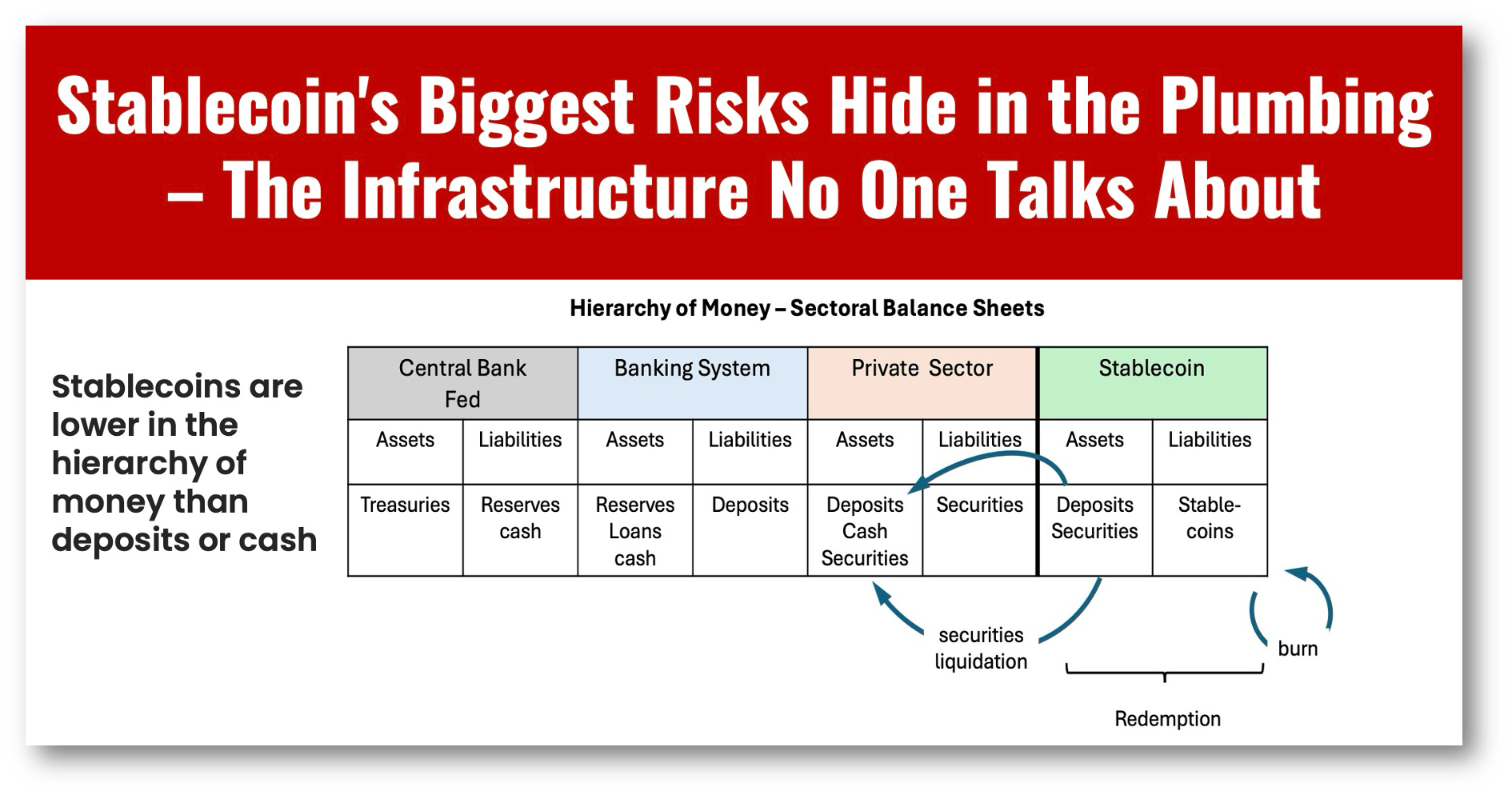
MIT looks at the risks hiding in stablecoins’ plumbing to show how holding a dollar peg depends not only on the quality of assets, the focus of the GENIUS Act, but on Treasury market forces and the reliability of public blockchain rails.
The narrative that stablecoins are simple products, easily understood and analyzed, is simply wrong and propagated by issuers who prefer retail users not understand that the current plumbing puts all of the risks on them.
Stablecoins are “structured products” with more in common with derivatives than government-issued currency.
The value of stablecoins is “derived” from their underlying portfolio, which, while tightly prescribed by the GENIUS act as US Treasuries, is still subject to the whims of markets.
The biggest problem for users is the assumption that the market for US Treasury securities is tranquil when it is turbulent.
This MIT paper brilliantly tackles the stress on stablecoins’ plumbing: redemption surges, market-intermediation bottlenecks, and technological disruptions.
The article is not entirely damning of stablecoins, but it shows:
↳ The simplistic view of stability sold by issuers is simply untrue,
↳ How the GENIUS Act left out more about maintaining stablecoin stability than it put in.
The authors argue that “durable stability will likely require an integrated approach spanning financial market infrastructure, prudential regulation, and software governance.”
On the GENIUS Act, the paper points out its STUNNING omissions on critical questions about liquidity support, redemption mechanics, capital adequacy, interoperability, technical infrastructure, and the long-run integration of stablecoins into the monetary system.
Stablecoins aren’t bad, but they aren’t the safe, simplistic products they’re advertised to be, especially during times of financial stress.
