
Tokenization and AI Won't Kill the Middleman: The Casino Always Wins
Technology changes but the grip of exchanges and clearinghouses on markets doesn't.
I post daily, but deliver to your inbox every Sunday. Browse past newsletters HERE. Book Rich. Bring the speed of Asia to your next event HERE
Read me first
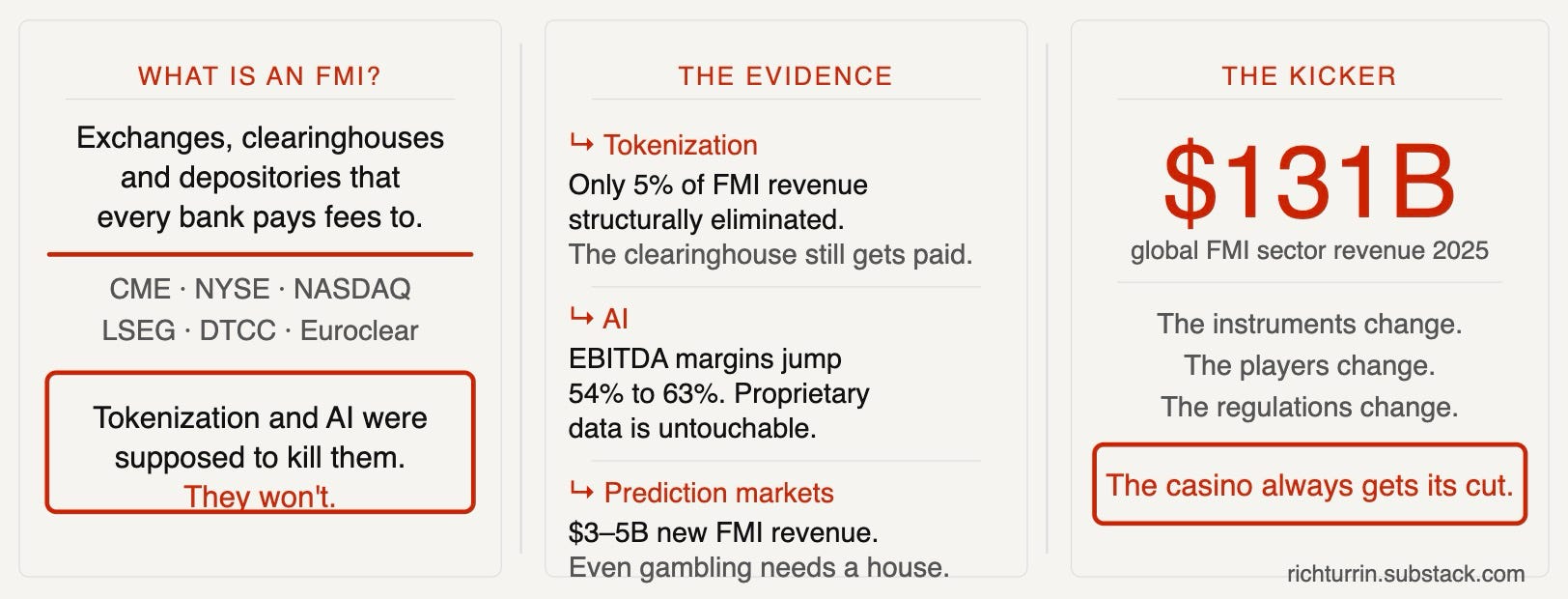
The casino always makes money. AI and tokenization were supposed to streamline and remove exchanges, clearinghouses, and lowly depositories. Instead, they are showing that they are the casino.
FMIs are the exchanges, clearinghouses, depositories, and data providers that receive fees from banking clients. Think: CME Group, NYSE, NASDAQ, LSEG, DTCC, Euroclear.
The narrative was simple: tokenization and AI would reduce their roles and make markets more efficient.
Funny how that isn’t going to happen.
Tokenization
Tokenization was supposed to disintermediate the FMIs.
Put assets on a blockchain, automate settlement with smart contracts, and suddenly you don’t need the clearinghouse in the middle.
That argument is already dead.
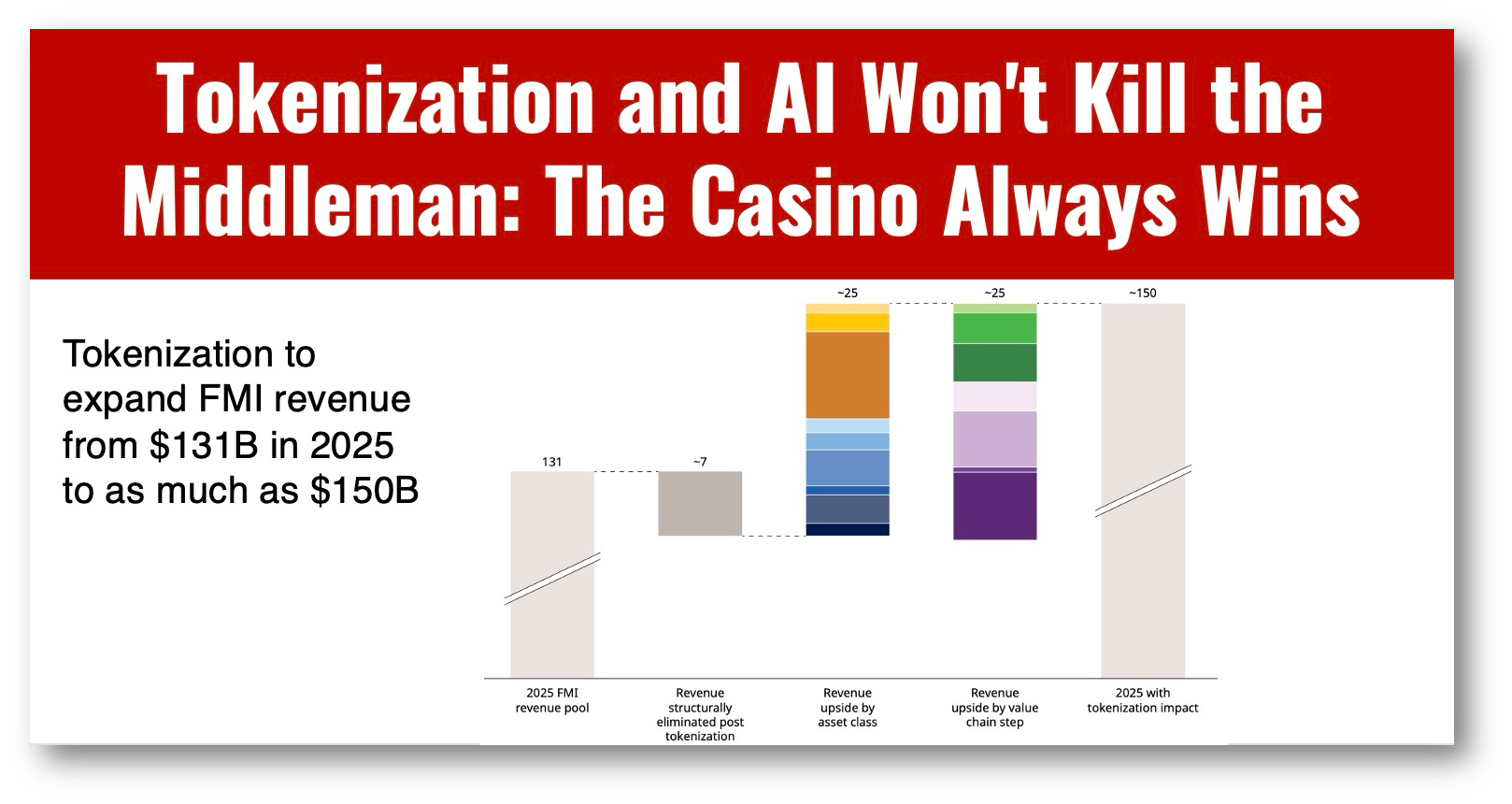
↳ The report shatters the “big savings” narrative with roughly 35% of FMI revenue migrating to new token-native rails, but only 5% gets structurally eliminated.
The clearinghouse still clears. The custodian still custodies. They just do it differently.
But wait, there’s more! Governments want their clearing revenues back.
Jurisdictions are actively building domestic infrastructure to repatriate settlement and custody economics currently captured by established Western FMIs.
FMI revenue isn’t just about technology, the geopolitical angle may be bigger than the technology one.
AI
AI is a gift to FMI providers.
AI loves data, and no one beats the likes of DTCC or CME for proprietary market data. The operative word is proprietary. Your AI isn’t going to get it off Google Finance.
Think about what FMIs actually own. Settlement records. Clearing data. Benchmark indices. Regulatory audit trails. Trade reporting. Datasets that took decades to build and are embedded deeply in client workflows. AI makes that data more valuable, not less.
↳ AI pushes FMI EBITDA margins from 54% to 63%, a roughly 10 percent jump, while creating $9 billion in new revenue potential.
To be fair, AI will hit FMIs’ more generic data analytics products, as clients can now replicate generic analytics and reporting in-house.
Prediction Markets
Let’s talk about the casino analogy in its most literal form.
Prediction markets are legalized gambling dressed in the language of finance. Your humble correspondent loathes them. People bet on elections, corporate collapses, weather disasters, and the most horrific events imaginable.
But loathing them is irrelevant. They need infrastructure, too.
↳ Oliver Wyman base case: FMI-addressable prediction market revenue of $3 to $5 billion annually, with 60 to 70% net new to the industry.
Crypto and DeFi-native platforms are so far running circles around FMIs in this sector. Whether that lasts is their problem to solve.
Compute as an Asset
Compute is emerging as a financializing commodity and will need FMI infrastructure too, but at under $1 billion in revenue potential, it barely registers against a $131 billion sector.
Conclusion
Whatever game finance invents next, someone has to run the table, and like it or not, that falls to incumbent exchanges, clearing houses, and others who will not surrender just because technology changes.
The instruments change. The players change. The regulations change.
The casino always gets its cut.
👉Strategic Positioning Choices
Market-of-record.
Winners will prioritize investments into asset classes with the highest secular growth. They will defend trusted post-trade economics as activity moves to new rails and new jurisdictions and build the institutional rails for new tokenized asset classes, event-risk markets, and other new contracts like Compute, before liquidity and data advantages lock in.System-of-work.
Winners will defend embedded technology positions where they sit deep in client workflows, fortifying the embedding and proprietary data and repricing for value. They will build token-aware and event-risk workflow modules to capture new markets.Source-of-origin.
Winners will defend data positions where content is proprietary, authoritative, regulatory-mandated, or embedded into client distribution. They will link exposed analytics into solutions anchored on these moats and reprice toward outcomes. Finally, they will build trusted reference, pricing, and event-data layers for tokenized asset classes and event-risk markets.Operating model.
Winners will treat AI as an operating-model lever, industrializing an “AI factory” that converts cost reduction into EBITDA margin uplift and unlocks the AI revenue upside at scale. They will also close the market-building capability gap relative to crypto and DeFi-native platforms and build the distribution, incentive, community, and product-launch capabilities that consistently turn new asset-class contracts into liquid markets.
HAND CURATED FOR YOU
🚀 Asia moves fast. So does this newsletter. I curate only the best fintech, CBDC, and AI insights from 50+ sources weekly so you stay ahead of what’s coming West. Subscribe and never fall behind.

If you know someone who would like this newsletter, please share it with them and help grow our Asia, CBDC, and AI aficionados community!
