
Tokenization: Speed Kills, Without Global Interoperability (Part 2 of a two-part series on tokenization)
The IMF's concerns about tokenization go beyond the hype
This is my daily post. I write daily, but send my newsletter to your email only on Sundays. Go HERE to see my past newsletters.
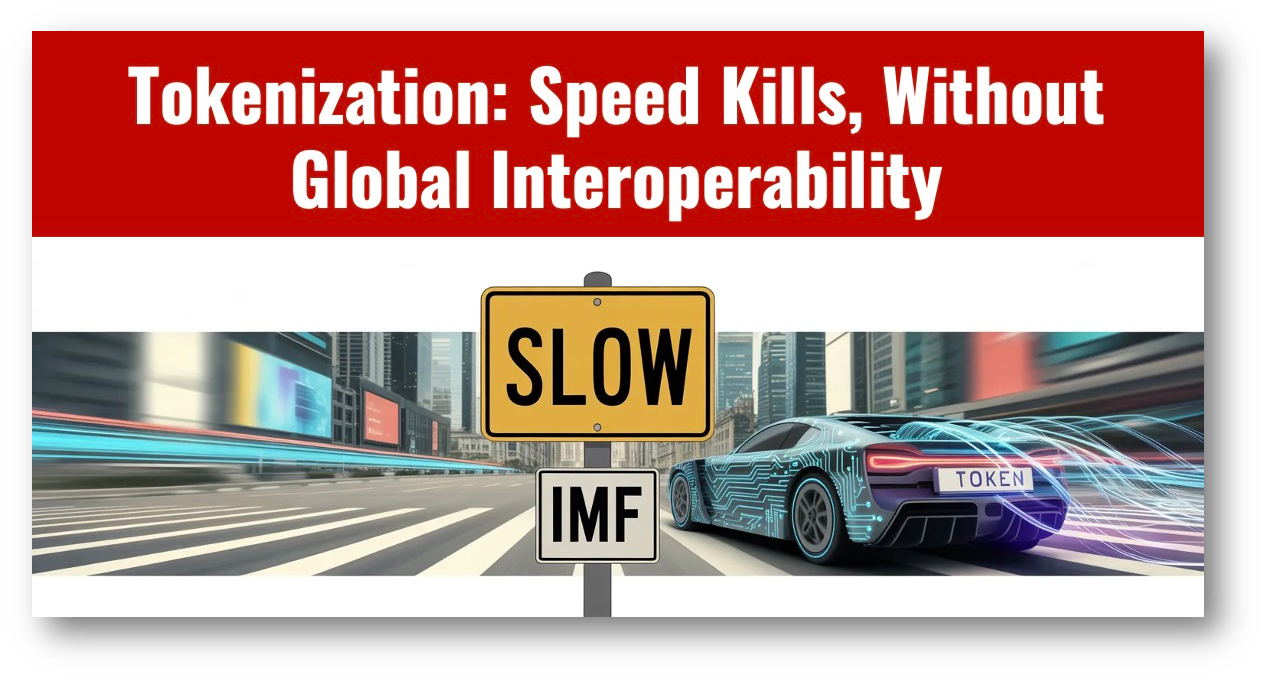
Tokenization promises to make finance faster but not safer, as the IMF warns that without global interoperability, faster just means less time for regulators to pump the brakes.
The IMF’s new Note on Tokenized Finance reinforces the notion that the speed of tokenized asset transfer brings real risks, stating:
“Stress events are likely to unfold faster, leaving less time for discretionary intervention.”
Speed Kills and Other Risks
The IMF does not debate that atomic settlement and programmable compliance are genuinely transformative and are positive developments.
But as I wrote in Part 1 of this two-part series, the same speed that eliminates counterparty risk can cause a liquidity crisis before any human can intervene.
Look to the 2010 algorithmic trading “Flash Crash” as an example of how speed kills.
The IMF calls out the specific risk of speed:
↳ Automated margin calls triggered by price movements can force rapid asset sales, reinforcing procyclical dynamics (see crypto markets for many examples)
↳ Settlement lags, yes, the “inefficiency” banks complain about, currently serve as temporal buffers, allowing liquidity to be mobilized before finality
↳ A faulty price feed or coding error can trigger cascading liquidations before any authority can respond
↳ Central bank standing facilities designed around business-day cycles are simply insufficient in a 24/7 tokenized environment
Risks don’t stop at speed:
↳ Fragmented platforms with incompatible settlement assets could trap liquidity in digital silos
↳ Smart contract errors can propagate instantaneously and autonomously, without any human in the loop (think crypto bridge smart contract attacks)
↳ Without a clear geographic anchor and with continuous operation, there is a mismatch with institutional jurisdictional controls
↳ Emerging economies face amplified currency substitution risk, with the overwhelming share of stablecoins currently denominated in U.S. dollars
The IMF also makes one distinction that crypto fans already know well.
It correctly states that tokenization represents a “structural shift” in financial markets because trust that once resided in the institutions, like banks and clearinghouses, is now migrating to blockchain infrastructure and code.
Part 1 of this two-part series on tokenization risk: Tokenized Securities Settlement: How Fast is Too Fast?
Stablecoins, wCBDC, or tokenized deposits for settlement?
As to digital settlement assets, the IMF looks to tokenized deposits, stablecoins, and wholesale CBDCs (wCBDC).
wCBDCs are considered the safest because they have no credit risk, but they have a major drawback in that they require central and commercial banks to build new infrastructure to use them.
